

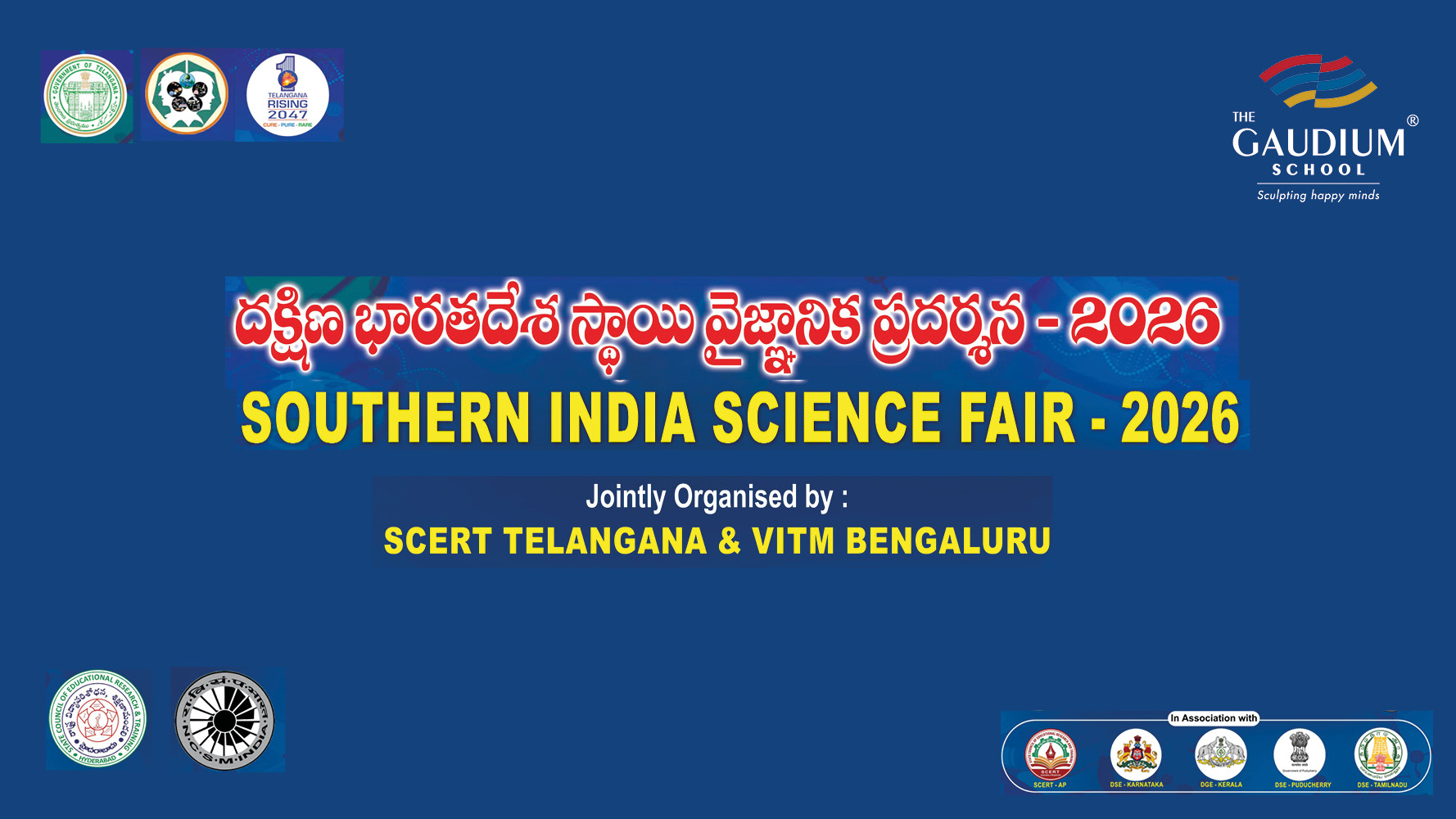
We are absolutely delighted to share that, as a distinguished segment of the SCERT India Science Festival (SISF), The Gaudium School had the rare privilege of hosting “Space on Wheels.” This one-of-a-kind mobile space exhibition was showcased in India for the very first time, making it a historic moment for our community. The arrival of this exhibition was not just a viewing opportunity but a catalyst for our students, who approached the event with the mindset of budding engineers and scientists. Their excitement went beyond mere observation; it was a demonstration of intellectual hunger, as they prepared to deconstruct the mechanics behind India’s greatest cosmic achievements.
This exclusive experience aligned seamlessly with our educational vision, specifically the initiatives driven by the Gaudium Space Lab. Because our students are already deeply engaged in hands-on exploration of astronomy, space science, and innovation within our curriculum, they were uniquely positioned to maximize this opportunity. They did not just look at the exhibits; they analyzed them. Leveraging the foundation built in the Space Lab, students engaged in high-level discussions about propulsion, orbital mechanics, and material science, demonstrating an innovative edge that transforms standard classroom learning into critical, real-world understanding.
The exhibition offered a fascinating, comprehensive glimpse into India’s inspiring space journey. Our students spent hours studying the specific engineering marvels displayed, including:
- Evolution of Indian launch vehicles
Students traced the engineering progression from the early SLV and ASLV to the workhorse PSLV and the heavy-lift GSLV Mk III (LVM3), noting the innovative shifts in fuel stages and payload capacities.
- Chandrayaan-III and Chandrayaan-4 missions
The students examined the model of the Vikram lander and Pragyan rover to understand the soft-landing technology of Chandrayaan-III, while eagerly hypothesizing about the complex sample-return architecture planned for the upcoming Chandrayaan-4.
- Mangalyaan – the Mars Orbiter Mission
This exhibit sparked discussions on frugal innovation, as students analyzed how India became the first nation to reach Mars on its maiden attempt using highly efficient orbital maneuvers.
- India’s first and second launch pads
The models of the launch pads at Sriharikota allowed students to visualize the critical ground infrastructure and the complex logistics required to support distinct launch vehicles.
- Indian navigation systems and remote sensing applications
Students explored the functionality of NavIC (India’s regional navigation system) and remote sensing satellites, discussing their innovative applications in disaster management, agriculture, and urban planning.
- The upcoming Bharatiya Antariksh Station
This forward-looking exhibit captured the imagination of our young innovators, who debated the design challenges and life-support systems required for India’s future independent space station.
- Artistic moon-surface views of astronauts
Visualizing humans on the lunar surface, this exhibit bridged art and science, inspiring students to imagine the future of space suit design and human survival on celestial bodies.
This immersive showcase significantly enriched our classroom learning and Space Lab initiatives by igniting curiosity, imagination, and scientific thinking. It was evident that our students were not just passively consuming information; they were connecting the dots between theoretical physics and applied technology. The innovative questions they raised regarding the future of space travel and sustainable technology proved that they are ready to contribute to the next generation of scientific solutions.
We were truly honoured to receive special approval and the unique privilege to host this remarkable exhibition and experience it together. It was a validation of our commitment to providing world-class exposure to our students. By bringing the cosmos to the campus, we have further fueled the innovative spirit of our young learners, empowering them to dream big and work towards a future where they are the ones designing the missions of tomorrow.

Leave A Comment